The Fuji Subaru Line 5th Station, explained
The 5th Station is the halfway point on Mount Fuji’s north side — a bus-accessible terrace at 2,305 m with a shrine, shops and the Yoshida trailhead. What it is not is a viewpoint for the mountain itself: you are standing on the thing you came to photograph. Here is the whole picture, from someone who worked up there for nineteen summers.
The Fuji Subaru Line 5th Station — Fuji Subaru Line Gogōme, if you want the Japanese — sits at 2,305 m on Mount Fuji’s north side, the most developed of the mountain’s four 5th stations and the trailhead of the Yoshida Trail, the most popular of the four routes to the 3,776 m summit. Direct buses reach it from Shinjuku in roughly 2.5 hours in season. What no brochure tells you is the first thing I told people at the information desk: you cannot see Mount Fuji from here.
I am Kenji Hoshino. I spent nineteen summers on the Yoshida Trail, first hauling supplies to mountain huts, later behind the information desk at this station, and I live in Fujiyoshida, below the north face. In those years I watched thousands of visitors step off the bus, turn a slow circle, and ask me where the mountain was. This page exists so you are not one of them.
The geometry, and the clouds
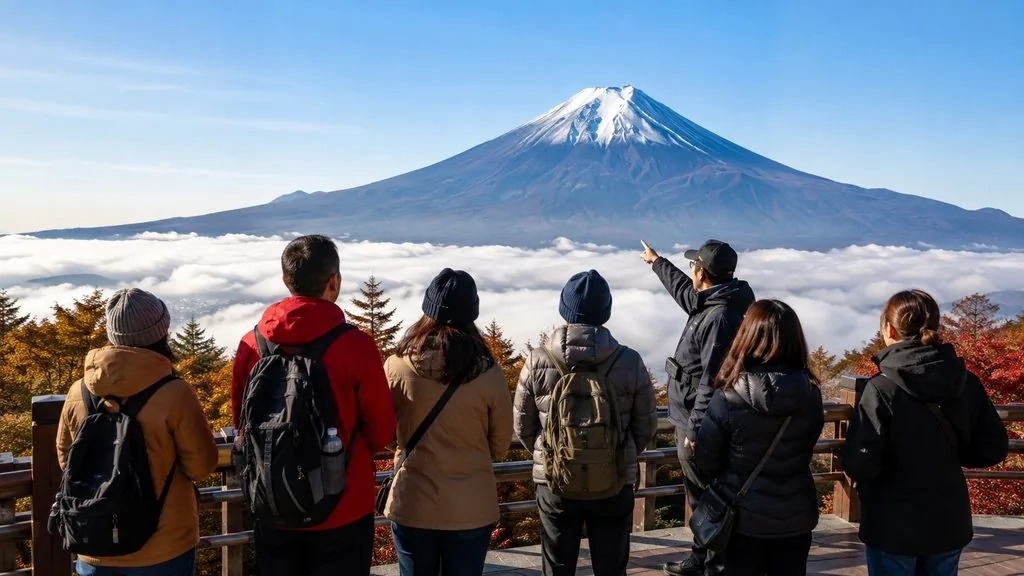
The problem is not the weather; it is the geometry. The 5th Station stands on Mount Fuji, so there is no cone to photograph — you look up at a bare summit slope and, on a good day, down onto a sea of clouds. The postcard views belong to the places below: Lake Kawaguchi and Oishi Park across the water, the Chureito Pagoda at Arakurayama Sengen Park at the top of a roughly 400-step climb, and the spring ponds of Oshino Hakkai (the full answer). Then the weather makes it worse: the station sits inside the cloud layer often enough that visitors regularly ride 2.5 hours from Shinjuku to stand in white fog, and no tour at any price can promise otherwise (clouds and visibility). In Japanese culture a clear view of Fuji is considered good luck. Sit with that sentence a moment — it is telling you the odds.
The paradox nobody prices in
The seasons run backwards here. Visibility is best in winter and worst from June to August — rainy, humid, cloud-wrapped — which is precisely when the official climbing season runs, early July to early September. The crisp days that put Fuji on calendars are winter days, when the summit is unclimbable and the road may be quiet. Within any single day, your best window is early morning, roughly 6 to 8 am, and Tuesday to Thursday is calmer than the weekend (when to come). Pack for the altitude either way: temperatures drop about 6 °C per 1,000 m, so a 30 °C day at the base is roughly 16 °C at the station, about 7 °C at the summit (what to wear).
See it, stand on it, or climb it
Every good decision about this mountain starts by picking one of three verbs. If you want to see Fuji, stay below: the viewing loop through Oishi Park, Lake Kawaguchi and Oshino Hakkai is the best-rated big product on this mountain at $49, and it never ascends — that is its point (the viewing tours). If you want to stand on Fuji, the flagship bus day brings you here at $151, with the Lake Ashi cruise, the Hakone ropeway and a Shinkansen return wrapped around the mountain hour — and when weather or the seasonal road rules shut the Subaru Line, it substitutes lower stops, which the operator says plainly and so do I. There is also a $50 budget way up, honest work but carrying only 16 reviews so far, and a $316 private car for up to five where the 5th Station is an optional stop “weather and road conditions permitting” (all six compared).
What is actually up here
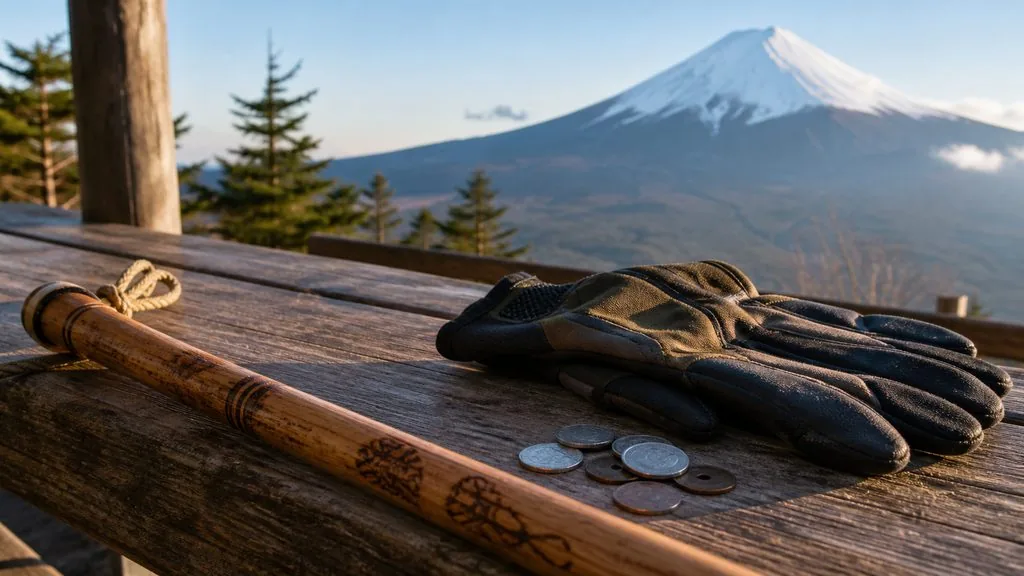
More than a car park. The small Fujisan Komitake Shrine predates the tourism — this has been a sacred mountain for centuries, a UNESCO Cultural World Heritage site since 2013, last eruption 1707 — and around it sit souvenir shops, restaurants and food stalls, coin lockers and public toilets. The melon bread is the famous snack; I have eaten more of it than I care to count. The standard advice is to spend an hour or two here, and it is sound twice over: it fits the shops and shrine, and it lets your body meet the altitude before any climb (what to do up here).
If you mean to climb
The Yoshida Trail leaves from this station: about six hours up, about four down, usually with a night in a mountain hut for sunrise. A mandatory per-climber fee applies — the current figure is listed on the official site, fujisan-climb.jp — and equipment checks happen at the trail entrance: hiking boots, rain jacket and rain pants, warm layers, never cotton. Respect the altitude; about 30% of climbers report at least mild sickness, and summit air carries roughly two-thirds of sea-level oxygen (how to handle it). And outside the season, do not. Trails are snowbound November to April, wind chills near −30 °C above the 8th station, winds of 40–50 m/s. Nineteen summers taught me where bravado ends (the climb in full).
That is the whole method. Pick your verb, then book the day that matches it — and if the cloud deck swallows the station anyway, buy the melon bread, touch the shrine gate, and remember you are standing on the thing everyone else is photographing.
Ready to book?
Check dates for the 5th Station flagship below, or start from all six tours compared.
Frequently asked questions
Can you actually see Mount Fuji from the 5th Station?
Not the postcard cone — you are on the mountain, looking up at the summit slope and down at the clouds. The full view lives at the lakes; here is the geometry.
Is the 5th Station worth visiting at all?
For standing at 2,305 m above a sea of clouds, yes — on a clear day. On a socked-in day there is no view in any direction. The honest cases for and against.
How do tours handle it when the road is closed?
The Subaru Line closes to private cars every climbing season and to everyone in bad weather; tours substitute lower stops. The road rules in full.